12.09.2010

Re: The Greatest Love Of All


A Conversation with Dan Fishback

@musicisfreenow: Not feeling bad about yourself is a revolutionary act

@dangerfishback: @musicisfreenow keep lowering the bar for revolution and we’ll never have a real one!

@musicisfreenow: @dangerfishback that’s the exact misconception. We all create this oppressive society by hating ourselves and then one another.

@musicisfreenow: @dangerfishback Facism, racism, homophobia, xenophobia are all fed by self hatred.

@dangerfishback: @musicisfreenow this is too complicated for twitter. i’m responding on my blog: www.danfishback.com

***

Cesar my friend,

I am profoundly irritated by the notion that facists, racists, homophobes (etc) are all just “feeling bad about themselves.” It creates a false equivalence between the oppressor and the oppressed, casting them all as victims. In truth, while a queer woman whose life is defined by harassment might “hate herself,” the heterosexist who tortures her probably doesn’t even fully understand what a human being is – at least not in any kind of holistic, spiritual, radical way.

I think dominant culture oppressors are moved, not by self-hatred, but by self-obliviousness, and an obliviousness to the true nature of humanity in general.

Moreover, I think all this focus on the self is really counter-productive, since truly revolutionary action and thought can probably only stem from realization of the interconnectedness of humanity. Not the love of self, but the explosion of the boundaries of the self. A redefining of the self to include the entire world. Which is why “not feeling bad about yourself,” when applied to the individual self, has nothing to do with revolution at all.

In fact, I think one of the most important revolutions that could possibly happen — the restructuring of society to make our lives sustainable and eliminate the mass importation and exportation of resources — is only possible if we GIVE UP being self-involved and self-entitled. That revolution will only happen if we make profound sacrifices on behalf of people who haven’t been born yet.

The reason why these kinds of revolutions don’t happen is precisely because we love ourselves too much, to the exclusion of the outside world.

I understand the spirit of your statement — that the key to changing the world may lie in the hearts of those who are destroying it — but I think your analysis, while attractive (Who doesn’t want to feel revolutionary just by liking themselves?), is too easy.

Love & Respect,
Dan

***

Dear Dan,

Thanks for your response. I still have to disagree.

Growing up in a family of leftist organizers I got taught a pseudo-marxist ideology early on that humans are fundamentally good and because of that when they are cared for and provided with opportunity they become their fundamentally good selves. Over my life I started to doubt that more and more. As I became present to the atrocities, hatred, violence and oppression that takes place every day in our world I arrived at the idea that humans might be fundamentally corrupt.

I've changed my mind now though. Mostly through my own recent exploration of personal distress I've started to feel that oppressive behaviors and structures in society are a response to personal trauma on a mass scale. I believe that violence and oppression on the part of the oppressor is always connected and stemming from the violence that they themselves experienced from living and growing in a society which enacted that oppression on them. People aren't born homophobic they are taught to be homophobic by others who have been taught that. We are programmed with fear from the beginning and the pain and distress of that programming inevitably comes out as illogical (and often oppressive) action.

"Not feeling bad about yourself" isn't about being "self-involved" (in fact self-involved people feel the worst about themselves). It is about unlearning hatred and healing the pain inflicted by a violent and oppressive world. This unlearning allows you to escape the cycle of re-inflicting trauma on others and perpetuating oppression. Part of the reason it is so hard not to dislike yourself is that we are all taught that self-confidence and self-love is "arrogance" "self-involvement" and "self-centeredness" when actually those things are all modes of insecurity caused by distress.

Having grown up for thirty years watching my nearest and dearest re-articulate what revolution is, I now believe that revolution is has to include personal re-emergence from trauma. Just like it has to include culture, policy, and social justice.

This isn't just about racists and homophobes not hating themselves, it is about all people healing and unlearning the self hatred taught to them by a society that handed them that. Everyone is hurt by hatred.

I didn't say "not feeling bad about yourself is revolution." I said it is a revolutionary act. And a revolution is one made of millions of acts. Healing from emotional and psychological wounds, and learning to value yourself fundamentally, is absolutely one of those acts.

With love and respect,

César


10.01.2010

Interview with Molly Rice

Reposted from Adam Szymkowski's Blog. This is a nice interview with FUTURITY Collaborator and spiritual super-genius Molly Rice


Molly Rice

Hometown: Born in Houston, TX, but Austin is home.

Current Town: New York City

Q: Tell me about the Saints Tour and Futurity the Musical.

A: SAINTS TOUR means a lot to me. I wrote the play in 2009 for Ray Rizzo's live arts exchange MOTHERLODGE, to take place in Louisville, KY. The play was a bus tour, led by a "Tour Guide" character who uncovers the secret saints of a local area. I wrote it using Google Maps Street View, never having been to Louisville, and Ray connected me to local musicians willing to be planted around the city for audiences to discover. Actress Emily Hyberger (a Louisville native), director/ writer/ actor Marc Bovino, and I went down and put the thing together in a week. And it was just magical. We had local sax player Mauriece echoing through the Salvation Army's cavernous 1950's gymnasium, and Louisville singer/ songwriter Tyrone Cotton singing about time in a graveyard, showered by white cherry blossoms, and so many other magical Louisville moments. We enlisted the Center of Hope Soup Kitchen, where the tour ended and we all ate a meal together. It was Community Theater, in the deepest sense of the word. I wrote it to be redesign-able for production in different communities, each time using a local actor and musicians, local sites, and a local community service organization-- so this Spring director Rachel Chavkin and I tested its flexibility in the West Village as a walking tour, with Taylor Mac as the Tour Guide and 20 participating artists and musicians (!!!). Totally different-- the Village itself was a character-- but totally interesting to see its translation. I plan to do it in as many cities as I can. The play is a story, but also a sort of frame to showcase these rich little pockets of culture out there that we sometimes lose sight of in New York. And as a writer, the sites just unfold into stories in the most exciting way.

FUTURITY is a beautiful example of a contemporary music/ theater hybrid. It was conceived and developed by the Lisps, a strange, smart Brooklyn band who I'd never heard of. I went and saw a presentation of FUTURITY at Joe's Pub in Spring 2009 because somebody sent me an email about it and it sounded cool, and I was like, this is fascinating-- there is something special here. I was touched by the way it balanced intellectual ideas with the emotional force of music. I felt like its book might need some development and that I might be a good match, so I connected with them and joined the team. The story is about a Civil War soldier and his imaginary relationship with mathemetician/ Lord Byron's daughter Ada Lovelace, which is fascinating enough, but at root the play's about the way science and art talk to each other, push each other forward, from one era to the next. I'm thrilled to be working on it.

I love working on strange music/ theater hybrids like these two. I was into music from early on--singer/ songwriter out of high school, went to Austin for college and promptly quit to play in bands. Music and story cleave to each other in my brain-- they're never fully separate strands of narrative. Even straight plays feel like compositions, and songs and compositions have a shape that feels like story. I'm interested in trying to 'braid' them in new ways, and with these two projects I'm still working it out.

Read the full interview HERE...

Paralyzing


New video From Zoe Boekbinder's Album Artichoke Perfume.
You can buy it HERE
The song is produced and co-written by yours truly.

9.12.2010

Extropian Records: Let's Build a New Music Industry


Image by Maggie Zander

Vision:

Extropian Records is a nonprofit record label that offers artists the benefits and support of a label without seeking profit or ownership of copyright. What we offer is an alternative model for enabling musicians to sustain their careers and gain exposure for their music. Any profit that Extropian makes beyond its initial investment will by law be funneled back into the pursuit of Extropian's mission: To enable musicians to thrive and to deliver powerful and brilliantly conceived music to the public.


Music is part of the fabric of culture. It is in the public interest that music be produced and distributed widely, and that artists be rewarded for and sustained by their work. A for-profit intermediary is not the only option for enabling musicians to succeed and their music to be heard.

Background:

The music industry, as it has existed for the last 120 years, is coming to an end. In that period businessmen and engineers converted the sounds produced by musicians into objects (cylinders, records, tapes, CDs), and then sold them, much as you would any product. After all was said and done, the artists who created the music might receive anywhere from 0 to 50% percent of the profits, and more often than not lose ownership of their masters. That model is still very much in play but it is no longer the only option. The creation, replication, promotion and distribution of recordings is newly and exponentially more accessible. That accessibility makes the old music industry upon which corporations and executives built fortunes increasingly unnecessary. One side effect of the success of the old music industry was that society at large started to view music more for its commodity power than for its mystical, cultural, intellectual, and transformative power. Music is magic, and the industry built around it was designed to serve the purveyors of business not the conjurers of that magic.

Independent Labels have presented themselves as the antidote to the "greedy majors." But indie labels mostly employ the same for-profit templates invented by major record labels. All major record labels, after all, were originally independent. Indies and majors seek the same thing: profit from music as a third party. There is nothing fundamentally wrong with the for-profit models of traditional record labels, but we believe that a nonprofit record label can serve the cause of music more effectively, creatively and humanely.

Extropian Records seeks to lessen the interference between fan and musician caused by profit-seeking business models, while still offering the capital, exposure and opportunity that an independent label would.

We are looking for people interested in helping to build this new model.

email: extropianrecords at gmail dot com to get involved.

César Alvarez

follow: @musicisfreenow

9.10.2010

The Table of Drops


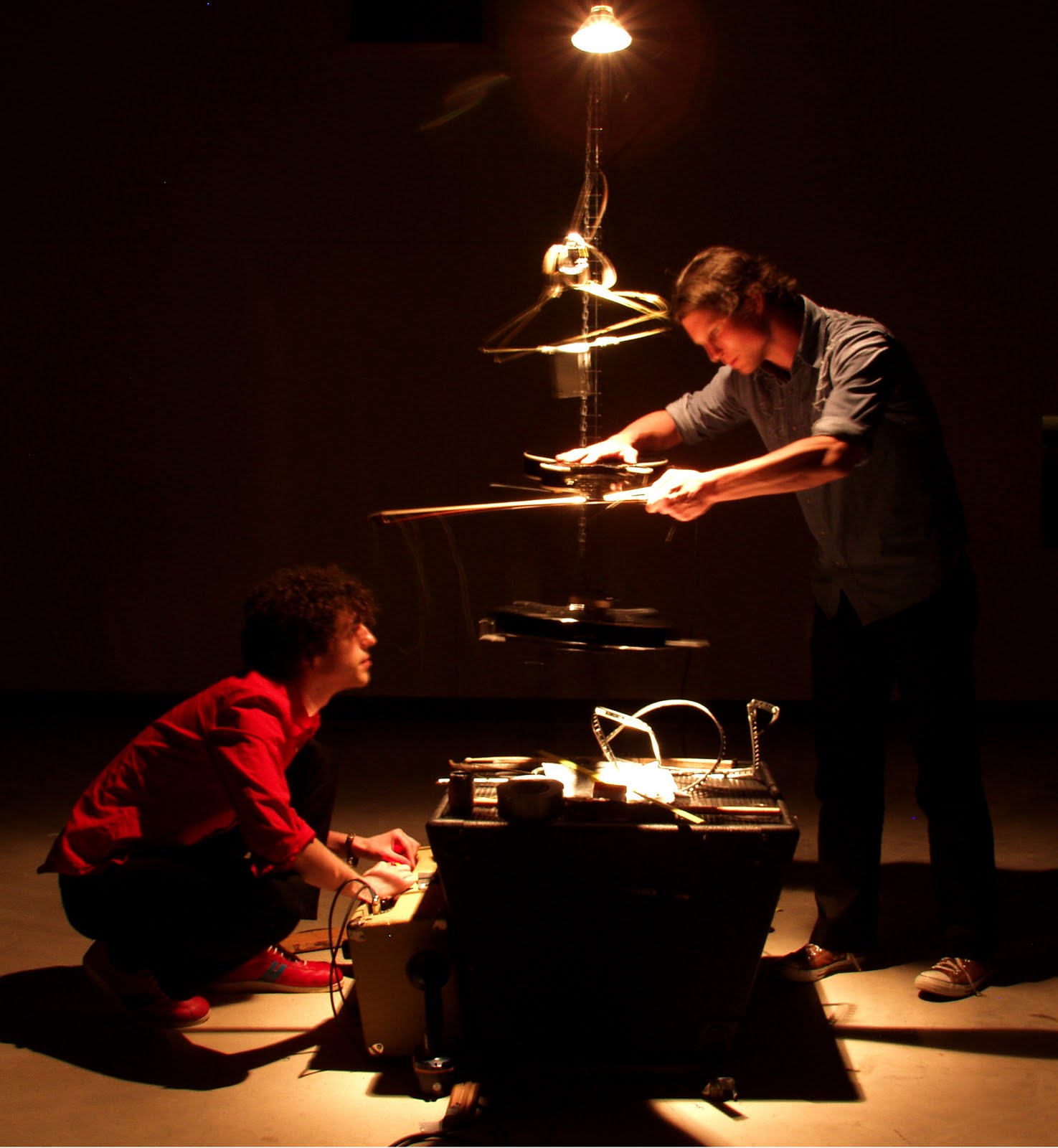
The Table of Drops is a performance environment designed by César Alvarez in which an electric guitar and a bass guitar are suspended face down over a large amplifier. Within a structured improvisation the performers use feedback, gravity, a variety of tools, and found materials to manipulate and excite the strings. I highly recommend listening to these on headphones, they work much better that way.

The Table of Drops

The Table of Drops by musicisfreenow

César Alvarez and Jeremy Hoevenaar - Objects, Guitars, Feedback

César Alvarez - Tenor Saxophone (on One)
Ei Arakawa - Voice (on One and A Number of Recent Pieces)
Michael Allman - Voice (on This Device and A Number of Recent Pieces)
Sammy Tunis - Voice (on A Number of Recent Pieces)
Text on Quarter by Jeremy Hoevenaar

Produced and Mixed by César Alvarez
Recorded at Bard College July 2006


9.08.2010

The Musical as Drama


So I just finished Scott McMillin's very amazing book, The Musical as Drama, on what was my first venture into a critical analysis of musical theater. One of McMillin's main points is that musicals have a subversive multiplicity to them because they operate on two orders of time: number time and book time. Which is to say that the time that passes during song is almost like a parallel dimension to the narrative action of the book. He emphasizes that, because of these two orders of time, the characters in musicals necessarily "double" themselves, and become two separate versions. This doubling uniquely enables a multiplicity and a sort of Brechtian alienation from a singular dramatic momentum.

"There is always a bit of cheek in the musical's revision of its sources." p. 52

"The heart of the musical is the projection of musical ability, which takes the performers into the second order of time, lyric time, and lets them extend their characters musically....The larger characters are capable of living in two worlds as though they were real and normal...They aren't, but we are glad to think they are" p.67

He says that the old imperative for an "integration" of the book and music is really a red herring, and that "coherence" is a better suited term for the form.

"Integration means the blending of difference into similarity...Coherence means things stick together, different things, without losing their difference. Most musicals are not political, but all musicals depend on conventions that translate into political terms. The political implication comes from the conventions of the musical itself, which establish a groundwork of doubled time and character, source stories reformulated into the routines of the show business, raids on private motives, most of us keep to ourselves in normal life, a delight in throwing authority off balance, and a desire to maintain song-and-dance formats that go back to Harlem and the Lower East Side. It is an illegitimate drama that disturbs the managers of our affairs the more it remains true to its roots in popular entertainment. Its aesthetic is radical, and that means its political potential is always there, as a matter of form. " p. 209

"I think the new shows will have what we have been talking about: a power of reflection running between the different modes of book and number, a sense of the irreverence of the genre, and a feeling for the anger and beauty of radical multiplicity." p. 211

I hope so!


"The Musical as Drama"
by Scott McMillin
2006 Princeton University Press

9.07.2010

Secret Salon II


We have Salons because venues aren't fun anymore. They are too loud, too expensive and too impersonal. Come somewhere special and really listen. You are going to have a great time.

When: Saturday September 18, 8pm
Where: Secret! RSVP to: the lisps at gmail dot com (fix the spaces)

FEATURING:
11pm The Lisps www.facebook.com/thelisps
10pm Agent Ribbons www.facebook.com/agentribbonsband
9pm Art Sorority for Girls www.myspace.com/artsororityforgirls


Here is the structure of the salon and we will look forward to seeing you there:

1. Once you RSVP (you have to rsvp via email. facebook rsvp is just for fun) you will be emailed the location 24 hours before the show. If for whatever reason you do not receive the email you can email thelisps@gmail.com
2. You may bring drinks or food or nothing at all.
3. there are 3 bands each will play for about 45 minutes.
4. Entrance is $5. This covers the basic cost of using the space and pays the musicians.
5. You are highly encouraged to come by 9 and stay for the entire evening.
6. Doors open at 8. Performances are at 9, 10, and 11pm.
7. Fancy Dress is also encouraged.
8. Location is in Brooklyn.
9. This is an 18+ event.

Thanks for participating and we look forward to seeing you there.

"That was really fun you should do that every month"
-Eric Farber after 1st Secret Salon

Sincerely,

César Alvarez
www.musicisfreenow.org
Share this on Facebook

7.29.2010

The Universe is a Small Hat


Other universes can get intoxicating, but ours is the one we are stuck with.
Many universes had to be tested to arrive at this one.
The specific qualities which ensure the possibility of life are unique and hard earned.
Multiple universes had to be tried on, stretched, re-purposed, folded, printed, rolled, curled, expanded, and imploded in order to know precisely which kind of universe could establish intelligence.

So feel lucky.
You are special.

The universe is a small hat worn by an enormous reserve of energetic potential.
It is one of trillions of accessories that completes the outfit of a primordial froth.

You are in a bubble.

You are a tiny bubble in a tiny bubble in an enormous foam of eternal consequence. It is no small thing that you can witness the edges of your own known universe.
You are everywhere right now.
Changes at one insignificant point can affect distant parts of the universe.
Your wave function extends into every known and unknown crevice of creation.
This is "Spooky action at a distance," and it is everything we have.
Try to appreciate it.

The fact of your existence has the same the likelihood of a laser telescope being assembled out of a pile of sand and a brisk wind. You are a small feat. You are deeply improbable.

Perhaps that is why so many of us are unhappy. Our sheer improbability is in a constant struggle against entropy. From day one we are forced to resist the Universe's desire to pull us apart and return us to non-existence.

It's hard to be an organized assembly of particles.


(Let's try to assemble a small neutron star out of metal parts.
That's the best way to keep ourselves afloat.)

7.27.2010

Music Is Science Fiction: An Interview With The Lisps

Reposted from LightSpeed Magazine
by
Desirina Boskovich

the lisps in futurity

Brooklyn-based band The Lisps definitely bring a unique element to New York’s indie rock scene. Quirky performances and eclectic sounds, influenced by folk and bluegrass, lend playful charm to lyrics-driven songs that are cerebral and wistful by turns. Their first full-length album, Country Doctor Museum, was released in 2008, following a debut EP titled The Vain, the Modest and the Dead. And, as far as we know, they’re the first indie rock band to write and produce an original, steampunk musical fusing science fiction, experimental music, and the Civil War.

FUTURITY follows the wartime experience of aspiring science fiction writer and lowly Confederate solider Julian Munro. While surrounded by destruction, Julian strikes up a correspondence with real-life metaphysician Ada Lovelace, history’s first female computer programmer. Together, the idealistic pair imagine a utopian future defined by an omnipotent machine that will end war once and for all.

Sammy Tunis and César Alvarez of The Lisps play the roles of Ada Lovelace and Julian Munro, backed by Lisps’ drummer Eric Farber. The play was written by Alvarez, and staged with the help of theatrical collaborators, as well as financial contributions from their fans, raised via Kickstarter.

Over the past two weeks, I’ve exchanged several e-mails with The Lisps. In the interview that follows, we touch on topics such as self-help songs, The Difference Engine, string theory, and, of course, The Singularity.

#

Desirina Boskovich: Broad question: what was the genesis for FUTURITY? What inspired your interest in Civil War history? Can you talk about the writing process for the musical?

César Alvarez: The idea for a concept album about a civil war soldier who was a science fiction writer literally just popped into my head while I was driving through Virginia in the fall of 2007. I held onto the idea for a while and then started working on it for my master’s thesis performance at Bard the following spring. The idea quickly turned into a musical. …[As] I started writing in this completely new form, I had no idea what I was doing. The early drafts of FUTURITY are bizarre lists and haiku-like texts. It has come a long way. The writing process has really been defined by the productions. If you count my thesis presentation at Bard, we’ve performed FUTURITY with four different casts in five different places. Each time we put the piece up the show is transformed, songs are added, characters developed, major plot points are changed, etc.

DB: When you first began working on the project, did you conceive it as a “steampunk” piece, or is that a term that came along as the project evolved?

CA: Definitely not. It is an aesthetic that we’ve used to our advantage but we didn’t want to define ourselves that way because it seemed limiting. William Gibson and Bruce Sterling’s novel The Difference Engine is something I read during my research period which was hugely influential, and I’m pretty sure it was that book that introduced me to the historical figure of Ada Lovelace. Also, Julian’s world is very rustic and messy, not the brass-encrusted fantasy of steampunk. So in Julian’s fantasy world, we like that his machine is made from rusty and dilapidated parts because that’s what his experience is.

DB: What were your aesthetic influences for the set design?

CA: The wonderful artist, and my soon-to-be wife, Emily Orling, did the set design. She is a visual artist and not a set designer and so she brought an atypical approach, I think. Her concept for the design was to use found and re-purposed objects as the raw material for the world. So there was very little in the way of set pieces, and scenery. Everything was a real object folded into an imaginary context. A lot of the drum set/Steam Brain was built by Eric Farber, our drummer. Pretty much everything that he used as percussion was something he found on E-Bay or in junk stores and then mounted to be part of his instrument. … Part of what we were doing was to create a science-fictional work out of things that a civil war soldier might see around him… Ada’s world was made from those kinds of materials, and even the natural landscape started to become mechanized and industrialized, but in an 1860’s sort of way. We also relish some choice anachronisms, and in no aspect of FUTURITY are we overly pious about any time period or historical narrative.

DB: One thing I loved about FUTURITY was the sensitive and sophisticated portrayal of Ada Lovelace, especially since the role of the female inventor is often overlooked in history and under-explored in science fiction. What inspired your interest in Lovelace, and how did you research her character?

CA: I first heard about Ada in The Difference Engine, and I was at the time really searching for how Sammy’s character was going to fit into the piece. Since this was supposed to be a musical for our band I needed both Sammy and I to have pivotal characters. Ada became the perfect link into the history of computing and such a great mentor/idol/muse for Julian. Their worlds couldn’t be more different and their relationship was so improbable that it was exciting territory. In earlier versions, Ada was imagined totally by Julian, but we found that her role had much more power if we made her real and invested in Julian.

the lisps in futurity 2

DB: César, in a letter to your fans about FUTURITY, you wrote: “I like to think of music as a form of Utopianism. For me, Music is science fiction.” Could you expand upon that?

CA: I like to think about string theory, wherein the entirety of the universe is made up of infinitesimal vibrating strings. Music is the perfect metaphor for the way the universe is built. Musicians create physical organization through pure vibration. Music is also one of the earliest forms of organization. Someone banging a rock in rhythm is a very early form of civilization. Music is the “civilization” of air through the organizing properties of rhythm and harmonics. So I hold music to be one of the most important ways that humanity envisions alternative forms of organization, which, in essence, is also what science fiction does.

DB: Regarding the themes of FUTURITY, you also wrote that “a feverish drive towards innovation is what keeps us alive and what can aid in our self-destruction.” Is this what fuels your interest in The Singularity? (Follow the link to read the lyrics and hear the song.)

CA: I’m so interested in technological singularity because it seems very relevant. Future shock used to be something shared among generations. At this point, every few years you need to adjust your technological tools and mindset to understand what is happening around you. I think the discussion about tech singularity helps me understand what technology means in the context of society and it gives a frame of reference. I don’t really subscribe to any Kurzweilian orthodoxy but I do think that the discussion is really fruitful.

DB: You describe your band as “the public/performative version of all the relationships you’re struggling with.” Besides the angst and rewards of 21st-century relationships, what other themes do you explore in your songs?

Sammy Tunis: Lately the themes of our songs haves touched less on personal relationships and more on science, space, time, The Singularity, and mathematics. The songs in the musical obviously follow somewhat of a narrative having to do with the relationship between scientific innovation and imagination, technological hubris and war, artificial intelligence, fantasy, etc, but there are also some pure love songs in there, too, and a lot of folk ballads. The songs on our forthcoming album really run the gamut as far as themes. …There are a few songs I like to obnoxiously call Self-Help songs: “you should do this and that”, a song called “Try” about trying new things, and a song called “Psychological Health.” Cesar’s about to get married, so a lot of the songs were written when he was falling in love with and living with his girlfriend and fall more in the domestic/love realm…

the lisps in futurity 3

DB: SF-themed music boasts a venerable tradition, from David Bowie and Sonic Youth to the Flaming Lips and Deltron 3030, etc, etc. What are your favorite “sci-fi songs,” other than your own, obviously?

CA: My favorite sci-fi song is “Two-Slit Experiment” by Jess Segal. I was also hugely influenced by The Flaming Lips album Yoshimi Battles the Pink Robots, though you might not hear it in my music. I grew up almost exclusively listening to jazz and then came really late (in college) to most rock/pop music. I’ve probably read more sci-fi than listened to it.

DB: Besides The Difference Engine, what science fiction books and stories have been influential for you? Or maybe just fun to read?

CA: Mary Shelley’s Frankenstein was really important for FUTURITY, because it dealt with so many of the same issues and was in a pre-computer time frame. Other books I love: Neuromancer, Parable of the Talents, The Forever War, Accelerando, 2001, The Final Question. Also, I have to give credit to Betty A. Toole, who was the first to transcribe Ada’s correspondence in her book The Enchantress of Numbers. Though that is all science fact, we relied heavily on her research for FUTURITY.

#

The Lisps are currently working on the next incarnation of FUTURITY, along with a FUTURITYAre We at the Movies? is slated for release this fall. Meanwhile, Alvarez is working on his next musical: M-Brane: A Splendid Dimension, a story about string theory and two untrained astronauts on a four-year space journey. concept album for full production in 2011, and their third album, tentatively titled

To learn more about The Lisps, hear their music, and find out where and when they’re performing, visit them on Facebook and Myspace.

5.19.2010

Lanier’s Singularity


This article in h+ Magazine gives a nice middle of the road argument about a technological singularity. Without spilling into technocalypse fantasy, it manages to state some good frameworks for thinking about the future.

'If a singularity ever happens, it would have two future outcomes. It would make tomorrow “fast” and “strange.” The physicist Michio Kaku divides “impossibilities” into three categories, which he calls types I, II and III. Basically, type I is anything that either has a rough working prototype, or at least some basic practical proof-of-principle. Type II refers to possibilities on the very edge of our understanding, concepts likely to remain entirely theoretical for many generations to come. Type III are those things which are ruled out by the known laws of physics.'

Read the Article

5.15.2010

T Pain Remix


I don't know what got in to me...but i remixed this T Pain song.
I tried to embed some commentary. Enjoy!

Take Your Shirt Off - César Alvarez Remix [mp3]

5.09.2010

Consumer Culture, Post-Scarcity, String Theory


Sculpture: "The Great Indoors" by Aurora Robson Photo Cred

Questions from my student Alberto De Icaza and Jaime Arreola

What's consumer culture for you?
Consumer Culture is a process by which people only interact with the creative dimension of human activity through purchases, marketing, and consumption. It is the fusing of the traditional act of experiencing creativity by humans with the viral/vermin activity of consumption/colonization.


How has it affected society?
That is a long and complicated question, but I have to admit that I'm not a anti-market idealist. I think that a regulated free market creates the possibility for innovation and art. I'm most interested in the fact of our scarcity economy. Which means that our entire economy is based on the idea that resources for survival are scare and therefore valuable. In this framework millions of people are without the means for a happy and healthy life. I believe that our scarcity economy won't last very much longer in the scheme of things. Once science is able to effectively manipulate material at the quantum level abundance will be the law. This however is a trade off, because we will be dealing with a dismantling of nature. Millions of other problems will emerge in a post-scarcity economy: nano-toxicity, out-sourcing of human activity, runaway economic models, etc. We think we have a consumer culture now, wait until our economy starts to harvest celestial bodies for raw materials. We will long for the days when people just wanted a house.


How has it affected Art?
I believe that culture (and by extension art) will always have a tricky relationship to consumption. Artists generate, and that calls out for someone to consume/experience. I can't in good conscience disown generative activity, because that is why there is something instead of nothing. The Universe (Multiverse) generated matter. Humans have been trying to understand that through art and science forever.

We shouldn't disown consumption completely because it is fundamental law of nature. From a scientific perspective, consumption is just the front end of the transformation of materials. Matter changes form but never (or rarely) ceases to exist. Many people are worried about the earth, but the earth will go on for a very long time, it's life that we are endangering. We can look out into the universe and witness how rare life is. It is immensely improbable that we've been able to evolve into intelligent life. What we are doing through thoughtless consumption is reconverting the world back into something that doesn't sustain life. That was the same state it was in for billions of years (Venus is an example of a planet with a runaway greenhouse effect). So I think that whether we like it or lot, the only way out is to generate a solution. It is too late to "Stop Consuming" in order to "Save the Earth." Those are cliches that don't own up to the way that humans really act. To generate a solution is the great responsibility of artists, visionaries, scientists, and everyone alive right now.


How has it affected Music?
Music is like the earth. It lives on in spite of all of the hideous things that people do on its surface. The music industry is eating itself (metamorphosing), which is fun to watch, but ultimately that is all surface work. People will continue moving in rhythm and collectively enjoying repetitive and patterned organizations of sound. It is part of the fabric of humanhood. Music is one of humanity's most astute re-enactments of the nature of quantum reality (string theory). It's hard to even talk about string theory without invoking music as a metaphor (for me anyway). So maybe the better question is, how will music (and musicians) enable us to finally understand reality?


Is there a solution for it?
Sounds like you wanted an answer I didn't give. I think there are solutions for everything, but they require us to understand that we can't think well enough yet. I like to ponder the leap that Einstein made when he realized that Gravity and Time are relative and that the speed of light is a limit. In this discovery he leaped into an entirely inconceivable echelon of thinking, and he pulled all humanity with him. That needs to happen many more times for humans to survive and understand what is really happening in our Universe.

5.05.2010

Why is there Something instead of Nothing?

So I was visiting my friend George Raggett at his delightful and commericial/non-commercial hybrid art/charity/kiosk/installation called The Museum of Commerce. It was spectacular to just be so confused by the purpose of a place of business. I was lucky enough to see someone else come by and be confused too. In a gallery, I get to experience art but I feel the constant (and threatening) hum of business underneath the surface of every piece. George has flipped that on its head. He's plopped himself in and among chic DUMBO boutiques, while maintaining a commitment not to sell hardly anything but a $2 catalog with no writing in it (half the proceeds go to Haiti) and he gives you a free poster just for walking in the door. This is a brilliant new business model: Don't sell anything or try to make money, just act like a business. And odds are it's going to work out great in the art world. I think there are a lot of scenarios in our current economics where the more money you make the less you have. George elegantly enacts that paradox for us. While sitting on a chair that he will admit he stole from his kitchen table at home. Music is free now, and so is art apparently.