
Here are 3 videos that have been hacking my own thoughts about music. All of them have a distinctive non-western approach to melody, harmony and rhythm, and they are each incredibly catchy. My jazz training has given me a feeling that chord changes are "the bones" of a song, but the more I look outside of western music the more I realize how melodic and rhythmic exploration inside of more static harmonies can be deeply gratifying. I realize that many western musicians have explored modal music, but each of the examples below has a deep folkiness that is riveting and truly different than much of what I've heard. None of these songs feel like an experiment but rather a continuation of a musical tradition that has been in process for centuries (With the possible exception of some of Wu Man's extended techniques). The thing that is so interesting about all three of these pieces is that they each have a "hook." They all force me to reconsider what makes music enjoyable, addictive, and the extent to which computers have homogenized the sonic reach of popular music around the world. This is ironic because I actually believe that computers are supremely versatile instruments, however they allow for a laziness that can end up eliminating nuance. I do think that computers are creating music that helps us process our computerized lives (eg: dubstep), just as ancient music helped people understand pre-industrial life. But just as our use of technology might become more organic and integrated into our humanity so might our music. These musicians all have a lot of information about what music means for humanity.
Kalumbu Song from Zambia
Pipa Song from China
Song from the Carnatic Indian Tradition (Southern India)
Showing posts with label electronic music. Show all posts
Showing posts with label electronic music. Show all posts
5.24.2012

11.13.2011
Ontology of vibration: economics, music and number
 |
| Photo Cred |
"Is it possible to approach developments in music by its relationships with money? Can we gain insight into societies by means of their relationship to music? Music serves as a mirror, as a prophecy for society because it reflects developments faster than anything that materializes.
There is an obvious simultaneity between music and economical developments, between music and mathematics and between mathematical and economical relationships. How better could we navigate through these dichotomies than through number, their common foundation? Ultimately, while we look at the connections between both number and music, how does music and its matter, frequency, correspond to (an ontology of) number? This mix revises some of the more recent musical works explicitly drawing from mathematics and number."Listen HERE
Pdf HERE
10.31.2011
An Alternative Pedagogy for the 21st Century Musician
 |
Student group - Fara Enclave (photo by César Alvarez)
|
In 2008 I was asked to teach a single course in the Music Tech division of the Creative Arts and Technology Department at Bloomfield College called "Digital Audio Engineering 1." I approached the class as a composer, producer and sound artist assuming that most of my students would be primarily interested in figuring out the studio tricks to make their tracks sound radio loud, compressed and commercial. I was right to a certain degree but what I did not expect is that they were hungry for a set of fundamentals around which to build a mature and unorthodox artistic practice. What sets the students in this program apart is that most have not been through traditional high school music programs but arrive at the practice of music making through their home computers. They are an entire crop of computer musicians that are from diverse backgrounds and musical tastes, and have little in common musically with the experimental electronic musicians that for decades have owned the title "computer musician." Home computers are enabling a whole generation of young people to make music without access to traditional musical instruments (much as the turntable did in the 1980s). Now a lot of these musicians are looking for a way to pursue that interest as part of their higher education. These musicians are the future of the music industry.
After seven semesters and 100s of classroom hours at Bloomfield I've started to identify an emergent framework for undergraduate study of "studio" music as a combination of creative and technical practice with historical and cultural study. The music industry is undergoing a cataclysmic transformation right now. and from what I can tell (looking at job postings and course offerings) many music departments at colleges and conservatories are stubbornly resisting the uncomfortable questions that this transformation raises for their curricula and pedagogy. I believe that creative and cultural workers will be highly sought after in the 21st century economy yet many of our music majors are being given a seriously dated education that ill-prepares them for this exciting yet dangerously uncertain field. Furthermore, many musicians are being excluded wholesale from the serious study of music because they lack the traditional pre-requisites (instrumental training, knowledge of jazz or classical music, ability to read music, etc) or because they are interested in popular music. My students have many careers open to them and most will wear several hats in order to collage together a respectable living as an artist. They will be performers, composers, recording artists, engineers (recording, mixing, mastering), sound designers, producers, bloggers, DJs, venue owners, bookers, teachers and live sound engineers. They will work at record labels, game design firms, post-production houses, event companies, marketing firms, radio stations, studios, internet start-ups, and even for sports teams. And their musical training will serve them in all of these roles.
After seven semesters and 100s of classroom hours at Bloomfield I've started to identify an emergent framework for undergraduate study of "studio" music as a combination of creative and technical practice with historical and cultural study. The music industry is undergoing a cataclysmic transformation right now. and from what I can tell (looking at job postings and course offerings) many music departments at colleges and conservatories are stubbornly resisting the uncomfortable questions that this transformation raises for their curricula and pedagogy. I believe that creative and cultural workers will be highly sought after in the 21st century economy yet many of our music majors are being given a seriously dated education that ill-prepares them for this exciting yet dangerously uncertain field. Furthermore, many musicians are being excluded wholesale from the serious study of music because they lack the traditional pre-requisites (instrumental training, knowledge of jazz or classical music, ability to read music, etc) or because they are interested in popular music. My students have many careers open to them and most will wear several hats in order to collage together a respectable living as an artist. They will be performers, composers, recording artists, engineers (recording, mixing, mastering), sound designers, producers, bloggers, DJs, venue owners, bookers, teachers and live sound engineers. They will work at record labels, game design firms, post-production houses, event companies, marketing firms, radio stations, studios, internet start-ups, and even for sports teams. And their musical training will serve them in all of these roles.
Below I've begun to document some of my observations and classroom experiments in order to start a dialogue about non-conservatory non-traditional undergraduate music education, both to document them for myself and hopefully to initiate a dialogue about the future of the music industry through the lens of some its youngest participants. I've also included a resource list at the bottom of the post.
Here are some of the basic concepts and distinctions that I employ in my classes along with brief explanations:
9.05.2011
Omnichord
Here's an improvisation I did on the very clumsy little beast that is Suzuki's Omnichord. This instrument is absurd, but a really fun to play...
9.10.2010
The Table of Drops
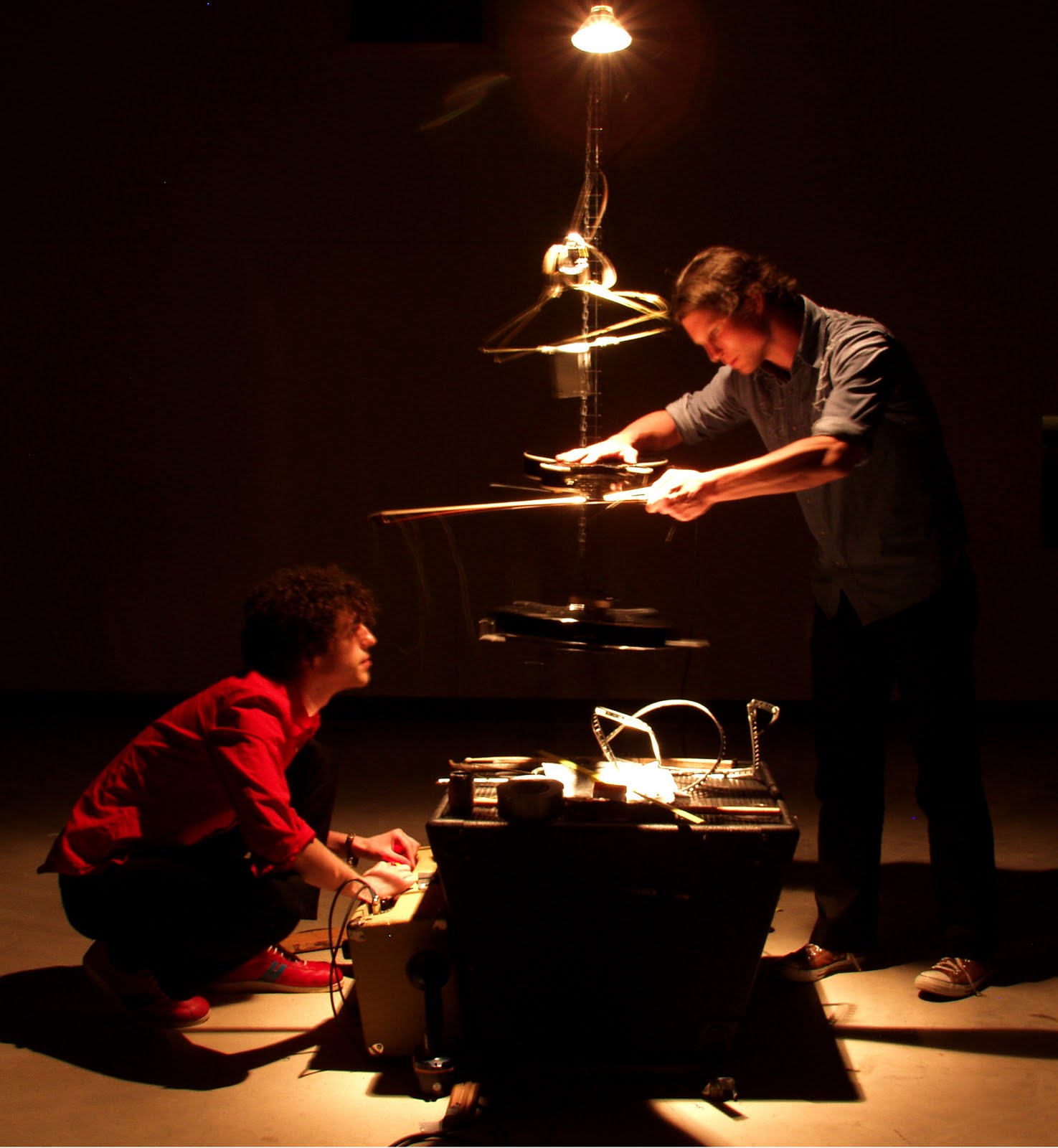
The Table of Drops is a performance environment designed by César Alvarez in which an electric guitar and a bass guitar are suspended face down over a large amplifier. Within a structured improvisation the performers use feedback, gravity, a variety of tools, and found materials to manipulate and excite the strings. I highly recommend listening to these on headphones, they work much better that way.
The Table of Drops
The Table of Drops by musicisfreenow
César Alvarez and Jeremy Hoevenaar - Objects, Guitars, Feedback
César Alvarez - Tenor Saxophone (on One)
Ei Arakawa - Voice (on One and A Number of Recent Pieces)
Michael Allman - Voice (on This Device and A Number of Recent Pieces)
Sammy Tunis - Voice (on A Number of Recent Pieces)
Text on Quarter by Jeremy Hoevenaar
Produced and Mixed by César Alvarez
Recorded at Bard College July 2006

1.02.2010
Mutant Sounds

If you aren't familiar with Mutant Sounds it is definitely worth a visit. It is a wonderful site dedicated to unearthing rare recordings and making them available to curious ears everywhere. I just downloaded this V.A. sounds compilation and I'm loving it.
7.09.2007
Red and Blue

Composer Zeljko McMullen just posted his new double album Red and Blue.
It's a formidable amount of music, and wonderfully crafted. The recordings are binaural and best listened to on headphones. However I got a chance to listen to Blue in a 10.2 ( i think) speaker arrangement. I haven't listened to every track but here are some things it makes my think about.
1. Hypnosis
2. Mental Transport
3. How does the emotional intensity of sound operate in relation to volume.
4. Bass Fatigue/Addiction
5. I think I'm very well suited for the recorded version rather than the installed, because I have a hard time with loud music in general (aka low threshold of pain), but I also don't completely like headphones, because a major aspect of these pieces is bodily.
6. The intense bass is what at times gave me the most pleasure and at times drew me out of the music.
7. The spaces between the pieces can become very enjoyable.
8. memory = resonance
9. commitment to a certain sound world.
10. vertical musical form?
[mp3] - Zeljko McMullen - diffusion (from Red),
[mp3] - Zeljko McMullen - blue (from Blue)
Also check out Zeljko's other projects Sadjeljko and Shinkoyo

Composer Zeljko McMullen just posted his new double album Red and Blue.
It's a formidable amount of music, and wonderfully crafted. The recordings are binaural and best listened to on headphones. However I got a chance to listen to Blue in a 10.2 ( i think) speaker arrangement. I haven't listened to every track but here are some things it makes my think about.
1. Hypnosis
2. Mental Transport
3. How does the emotional intensity of sound operate in relation to volume.
4. Bass Fatigue/Addiction
5. I think I'm very well suited for the recorded version rather than the installed, because I have a hard time with loud music in general (aka low threshold of pain), but I also don't completely like headphones, because a major aspect of these pieces is bodily.
6. The intense bass is what at times gave me the most pleasure and at times drew me out of the music.
7. The spaces between the pieces can become very enjoyable.
8. memory = resonance
9. commitment to a certain sound world.
10. vertical musical form?
[mp3] - Zeljko McMullen - diffusion (from Red),
[mp3] - Zeljko McMullen - blue (from Blue)
Also check out Zeljko's other projects Sadjeljko and Shinkoyo
Subscribe to:
Posts (Atom)

