9.07.2010

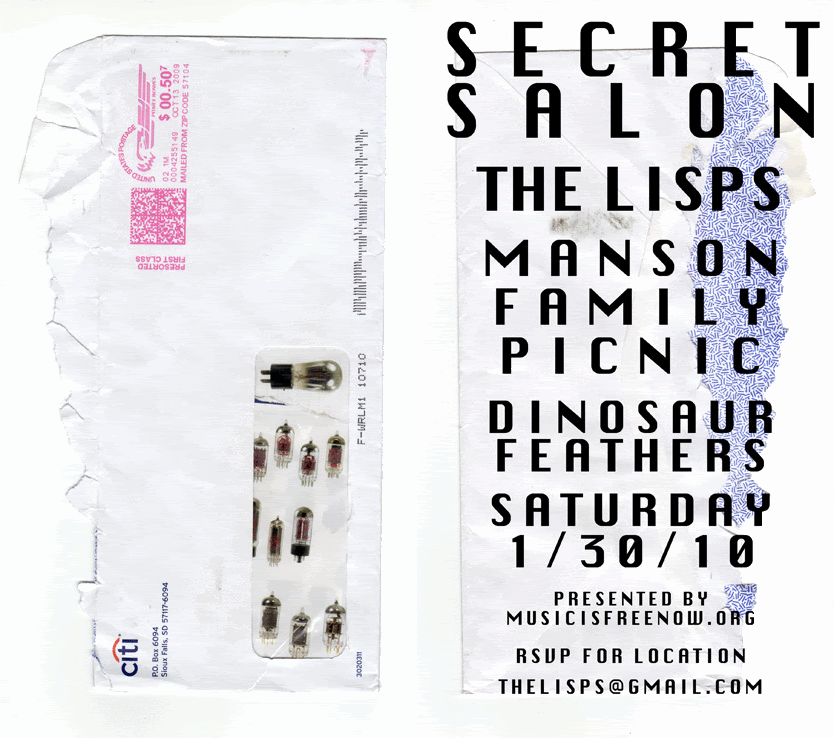
Secret Salon II


We have Salons because venues aren't fun anymore. They are too loud, too expensive and too impersonal. Come somewhere special and really listen. You are going to have a great time.

When: Saturday September 18, 8pm
Where: Secret! RSVP to: the lisps at gmail dot com (fix the spaces)

FEATURING:
11pm The Lisps www.facebook.com/thelisps
10pm Agent Ribbons www.facebook.com/agentribbonsband
9pm Art Sorority for Girls www.myspace.com/artsororityforgirls


Here is the structure of the salon and we will look forward to seeing you there:

1. Once you RSVP (you have to rsvp via email. facebook rsvp is just for fun) you will be emailed the location 24 hours before the show. If for whatever reason you do not receive the email you can email thelisps@gmail.com
2. You may bring drinks or food or nothing at all.
3. there are 3 bands each will play for about 45 minutes.
4. Entrance is $5. This covers the basic cost of using the space and pays the musicians.
5. You are highly encouraged to come by 9 and stay for the entire evening.
6. Doors open at 8. Performances are at 9, 10, and 11pm.
7. Fancy Dress is also encouraged.
8. Location is in Brooklyn.
9. This is an 18+ event.

Thanks for participating and we look forward to seeing you there.

"That was really fun you should do that every month"
-Eric Farber after 1st Secret Salon

Sincerely,

César Alvarez
www.musicisfreenow.org
Share this on Facebook

7.29.2010

The Universe is a Small Hat


Other universes can get intoxicating, but ours is the one we are stuck with.
Many universes had to be tested to arrive at this one.
The specific qualities which ensure the possibility of life are unique and hard earned.
Multiple universes had to be tried on, stretched, re-purposed, folded, printed, rolled, curled, expanded, and imploded in order to know precisely which kind of universe could establish intelligence.

So feel lucky.
You are special.

The universe is a small hat worn by an enormous reserve of energetic potential.
It is one of trillions of accessories that completes the outfit of a primordial froth.

You are in a bubble.

You are a tiny bubble in a tiny bubble in an enormous foam of eternal consequence. It is no small thing that you can witness the edges of your own known universe.
You are everywhere right now.
Changes at one insignificant point can affect distant parts of the universe.
Your wave function extends into every known and unknown crevice of creation.
This is "Spooky action at a distance," and it is everything we have.
Try to appreciate it.

The fact of your existence has the same the likelihood of a laser telescope being assembled out of a pile of sand and a brisk wind. You are a small feat. You are deeply improbable.

Perhaps that is why so many of us are unhappy. Our sheer improbability is in a constant struggle against entropy. From day one we are forced to resist the Universe's desire to pull us apart and return us to non-existence.

It's hard to be an organized assembly of particles.


(Let's try to assemble a small neutron star out of metal parts.
That's the best way to keep ourselves afloat.)

7.27.2010

Music Is Science Fiction: An Interview With The Lisps

Reposted from LightSpeed Magazine
by
Desirina Boskovich

the lisps in futurity

Brooklyn-based band The Lisps definitely bring a unique element to New York’s indie rock scene. Quirky performances and eclectic sounds, influenced by folk and bluegrass, lend playful charm to lyrics-driven songs that are cerebral and wistful by turns. Their first full-length album, Country Doctor Museum, was released in 2008, following a debut EP titled The Vain, the Modest and the Dead. And, as far as we know, they’re the first indie rock band to write and produce an original, steampunk musical fusing science fiction, experimental music, and the Civil War.

FUTURITY follows the wartime experience of aspiring science fiction writer and lowly Confederate solider Julian Munro. While surrounded by destruction, Julian strikes up a correspondence with real-life metaphysician Ada Lovelace, history’s first female computer programmer. Together, the idealistic pair imagine a utopian future defined by an omnipotent machine that will end war once and for all.

Sammy Tunis and César Alvarez of The Lisps play the roles of Ada Lovelace and Julian Munro, backed by Lisps’ drummer Eric Farber. The play was written by Alvarez, and staged with the help of theatrical collaborators, as well as financial contributions from their fans, raised via Kickstarter.

Over the past two weeks, I’ve exchanged several e-mails with The Lisps. In the interview that follows, we touch on topics such as self-help songs, The Difference Engine, string theory, and, of course, The Singularity.

#

Desirina Boskovich: Broad question: what was the genesis for FUTURITY? What inspired your interest in Civil War history? Can you talk about the writing process for the musical?

César Alvarez: The idea for a concept album about a civil war soldier who was a science fiction writer literally just popped into my head while I was driving through Virginia in the fall of 2007. I held onto the idea for a while and then started working on it for my master’s thesis performance at Bard the following spring. The idea quickly turned into a musical. …[As] I started writing in this completely new form, I had no idea what I was doing. The early drafts of FUTURITY are bizarre lists and haiku-like texts. It has come a long way. The writing process has really been defined by the productions. If you count my thesis presentation at Bard, we’ve performed FUTURITY with four different casts in five different places. Each time we put the piece up the show is transformed, songs are added, characters developed, major plot points are changed, etc.

DB: When you first began working on the project, did you conceive it as a “steampunk” piece, or is that a term that came along as the project evolved?

CA: Definitely not. It is an aesthetic that we’ve used to our advantage but we didn’t want to define ourselves that way because it seemed limiting. William Gibson and Bruce Sterling’s novel The Difference Engine is something I read during my research period which was hugely influential, and I’m pretty sure it was that book that introduced me to the historical figure of Ada Lovelace. Also, Julian’s world is very rustic and messy, not the brass-encrusted fantasy of steampunk. So in Julian’s fantasy world, we like that his machine is made from rusty and dilapidated parts because that’s what his experience is.

DB: What were your aesthetic influences for the set design?

CA: The wonderful artist, and my soon-to-be wife, Emily Orling, did the set design. She is a visual artist and not a set designer and so she brought an atypical approach, I think. Her concept for the design was to use found and re-purposed objects as the raw material for the world. So there was very little in the way of set pieces, and scenery. Everything was a real object folded into an imaginary context. A lot of the drum set/Steam Brain was built by Eric Farber, our drummer. Pretty much everything that he used as percussion was something he found on E-Bay or in junk stores and then mounted to be part of his instrument. … Part of what we were doing was to create a science-fictional work out of things that a civil war soldier might see around him… Ada’s world was made from those kinds of materials, and even the natural landscape started to become mechanized and industrialized, but in an 1860’s sort of way. We also relish some choice anachronisms, and in no aspect of FUTURITY are we overly pious about any time period or historical narrative.

DB: One thing I loved about FUTURITY was the sensitive and sophisticated portrayal of Ada Lovelace, especially since the role of the female inventor is often overlooked in history and under-explored in science fiction. What inspired your interest in Lovelace, and how did you research her character?

CA: I first heard about Ada in The Difference Engine, and I was at the time really searching for how Sammy’s character was going to fit into the piece. Since this was supposed to be a musical for our band I needed both Sammy and I to have pivotal characters. Ada became the perfect link into the history of computing and such a great mentor/idol/muse for Julian. Their worlds couldn’t be more different and their relationship was so improbable that it was exciting territory. In earlier versions, Ada was imagined totally by Julian, but we found that her role had much more power if we made her real and invested in Julian.

the lisps in futurity 2

DB: César, in a letter to your fans about FUTURITY, you wrote: “I like to think of music as a form of Utopianism. For me, Music is science fiction.” Could you expand upon that?

CA: I like to think about string theory, wherein the entirety of the universe is made up of infinitesimal vibrating strings. Music is the perfect metaphor for the way the universe is built. Musicians create physical organization through pure vibration. Music is also one of the earliest forms of organization. Someone banging a rock in rhythm is a very early form of civilization. Music is the “civilization” of air through the organizing properties of rhythm and harmonics. So I hold music to be one of the most important ways that humanity envisions alternative forms of organization, which, in essence, is also what science fiction does.

DB: Regarding the themes of FUTURITY, you also wrote that “a feverish drive towards innovation is what keeps us alive and what can aid in our self-destruction.” Is this what fuels your interest in The Singularity? (Follow the link to read the lyrics and hear the song.)

CA: I’m so interested in technological singularity because it seems very relevant. Future shock used to be something shared among generations. At this point, every few years you need to adjust your technological tools and mindset to understand what is happening around you. I think the discussion about tech singularity helps me understand what technology means in the context of society and it gives a frame of reference. I don’t really subscribe to any Kurzweilian orthodoxy but I do think that the discussion is really fruitful.

DB: You describe your band as “the public/performative version of all the relationships you’re struggling with.” Besides the angst and rewards of 21st-century relationships, what other themes do you explore in your songs?

Sammy Tunis: Lately the themes of our songs haves touched less on personal relationships and more on science, space, time, The Singularity, and mathematics. The songs in the musical obviously follow somewhat of a narrative having to do with the relationship between scientific innovation and imagination, technological hubris and war, artificial intelligence, fantasy, etc, but there are also some pure love songs in there, too, and a lot of folk ballads. The songs on our forthcoming album really run the gamut as far as themes. …There are a few songs I like to obnoxiously call Self-Help songs: “you should do this and that”, a song called “Try” about trying new things, and a song called “Psychological Health.” Cesar’s about to get married, so a lot of the songs were written when he was falling in love with and living with his girlfriend and fall more in the domestic/love realm…

the lisps in futurity 3

DB: SF-themed music boasts a venerable tradition, from David Bowie and Sonic Youth to the Flaming Lips and Deltron 3030, etc, etc. What are your favorite “sci-fi songs,” other than your own, obviously?

CA: My favorite sci-fi song is “Two-Slit Experiment” by Jess Segal. I was also hugely influenced by The Flaming Lips album Yoshimi Battles the Pink Robots, though you might not hear it in my music. I grew up almost exclusively listening to jazz and then came really late (in college) to most rock/pop music. I’ve probably read more sci-fi than listened to it.

DB: Besides The Difference Engine, what science fiction books and stories have been influential for you? Or maybe just fun to read?

CA: Mary Shelley’s Frankenstein was really important for FUTURITY, because it dealt with so many of the same issues and was in a pre-computer time frame. Other books I love: Neuromancer, Parable of the Talents, The Forever War, Accelerando, 2001, The Final Question. Also, I have to give credit to Betty A. Toole, who was the first to transcribe Ada’s correspondence in her book The Enchantress of Numbers. Though that is all science fact, we relied heavily on her research for FUTURITY.

#

The Lisps are currently working on the next incarnation of FUTURITY, along with a FUTURITYAre We at the Movies? is slated for release this fall. Meanwhile, Alvarez is working on his next musical: M-Brane: A Splendid Dimension, a story about string theory and two untrained astronauts on a four-year space journey. concept album for full production in 2011, and their third album, tentatively titled

To learn more about The Lisps, hear their music, and find out where and when they’re performing, visit them on Facebook and Myspace.

5.19.2010

Lanier’s Singularity


This article in h+ Magazine gives a nice middle of the road argument about a technological singularity. Without spilling into technocalypse fantasy, it manages to state some good frameworks for thinking about the future.

'If a singularity ever happens, it would have two future outcomes. It would make tomorrow “fast” and “strange.” The physicist Michio Kaku divides “impossibilities” into three categories, which he calls types I, II and III. Basically, type I is anything that either has a rough working prototype, or at least some basic practical proof-of-principle. Type II refers to possibilities on the very edge of our understanding, concepts likely to remain entirely theoretical for many generations to come. Type III are those things which are ruled out by the known laws of physics.'

Read the Article

5.15.2010

T Pain Remix


I don't know what got in to me...but i remixed this T Pain song.
I tried to embed some commentary. Enjoy!

Take Your Shirt Off - César Alvarez Remix [mp3]

5.09.2010

Consumer Culture, Post-Scarcity, String Theory


Sculpture: "The Great Indoors" by Aurora Robson Photo Cred

Questions from my student Alberto De Icaza and Jaime Arreola

What's consumer culture for you?
Consumer Culture is a process by which people only interact with the creative dimension of human activity through purchases, marketing, and consumption. It is the fusing of the traditional act of experiencing creativity by humans with the viral/vermin activity of consumption/colonization.


How has it affected society?
That is a long and complicated question, but I have to admit that I'm not a anti-market idealist. I think that a regulated free market creates the possibility for innovation and art. I'm most interested in the fact of our scarcity economy. Which means that our entire economy is based on the idea that resources for survival are scare and therefore valuable. In this framework millions of people are without the means for a happy and healthy life. I believe that our scarcity economy won't last very much longer in the scheme of things. Once science is able to effectively manipulate material at the quantum level abundance will be the law. This however is a trade off, because we will be dealing with a dismantling of nature. Millions of other problems will emerge in a post-scarcity economy: nano-toxicity, out-sourcing of human activity, runaway economic models, etc. We think we have a consumer culture now, wait until our economy starts to harvest celestial bodies for raw materials. We will long for the days when people just wanted a house.


How has it affected Art?
I believe that culture (and by extension art) will always have a tricky relationship to consumption. Artists generate, and that calls out for someone to consume/experience. I can't in good conscience disown generative activity, because that is why there is something instead of nothing. The Universe (Multiverse) generated matter. Humans have been trying to understand that through art and science forever.

We shouldn't disown consumption completely because it is fundamental law of nature. From a scientific perspective, consumption is just the front end of the transformation of materials. Matter changes form but never (or rarely) ceases to exist. Many people are worried about the earth, but the earth will go on for a very long time, it's life that we are endangering. We can look out into the universe and witness how rare life is. It is immensely improbable that we've been able to evolve into intelligent life. What we are doing through thoughtless consumption is reconverting the world back into something that doesn't sustain life. That was the same state it was in for billions of years (Venus is an example of a planet with a runaway greenhouse effect). So I think that whether we like it or lot, the only way out is to generate a solution. It is too late to "Stop Consuming" in order to "Save the Earth." Those are cliches that don't own up to the way that humans really act. To generate a solution is the great responsibility of artists, visionaries, scientists, and everyone alive right now.


How has it affected Music?
Music is like the earth. It lives on in spite of all of the hideous things that people do on its surface. The music industry is eating itself (metamorphosing), which is fun to watch, but ultimately that is all surface work. People will continue moving in rhythm and collectively enjoying repetitive and patterned organizations of sound. It is part of the fabric of humanhood. Music is one of humanity's most astute re-enactments of the nature of quantum reality (string theory). It's hard to even talk about string theory without invoking music as a metaphor (for me anyway). So maybe the better question is, how will music (and musicians) enable us to finally understand reality?


Is there a solution for it?
Sounds like you wanted an answer I didn't give. I think there are solutions for everything, but they require us to understand that we can't think well enough yet. I like to ponder the leap that Einstein made when he realized that Gravity and Time are relative and that the speed of light is a limit. In this discovery he leaped into an entirely inconceivable echelon of thinking, and he pulled all humanity with him. That needs to happen many more times for humans to survive and understand what is really happening in our Universe.

5.05.2010

Why is there Something instead of Nothing?

So I was visiting my friend George Raggett at his delightful and commericial/non-commercial hybrid art/charity/kiosk/installation called The Museum of Commerce. It was spectacular to just be so confused by the purpose of a place of business. I was lucky enough to see someone else come by and be confused too. In a gallery, I get to experience art but I feel the constant (and threatening) hum of business underneath the surface of every piece. George has flipped that on its head. He's plopped himself in and among chic DUMBO boutiques, while maintaining a commitment not to sell hardly anything but a $2 catalog with no writing in it (half the proceeds go to Haiti) and he gives you a free poster just for walking in the door. This is a brilliant new business model: Don't sell anything or try to make money, just act like a business. And odds are it's going to work out great in the art world. I think there are a lot of scenarios in our current economics where the more money you make the less you have. George elegantly enacts that paradox for us. While sitting on a chair that he will admit he stole from his kitchen table at home. Music is free now, and so is art apparently.

2.26.2010

Atemporality for the Creative Artist

Bruce Sterling's talk on atemporality deals with the internet's dismantling of our relationship to time and problem solving. In FUTURITY we've been thinking so much about presenting the past as future. This is helpful and brain-squeezing.


1.24.2010

The Secret Salon

Especially with the recent economic downturn, music venues seem to have become more and more anxiety ridden. People feel obligated to buy expensive drinks that they can't afford, venues feel obligated to create bills that have nothing to do with music and everything to do with the head count. The net result is that venues become uncomfortable Karaoke Dens and culture seekers/makers stay home, save their pennies and find free culture online. What we lose in this chain reaction is enormous. We lose the direct exchange between artist and appreciator, the cross pollination of like minded artists, and the joy of experiencing one another without mediation as people in the flesh.

I decided to put together this Salon because I just wanted a chance to play and present music for people that want to listen to, experience and exchange music. I wanted to do it in a context that is unmediated by a business plan or non-intersecting artistic goals.

Here is the structure of the salon and we will look forward to seeing you there:

1. Once you RSVP you will be emailed the location 24 hours before the show. If for whatever reason you do not receive the email you can email thelisps @ gmail . com (fix the spaces)
2. You may bring drinks or food or nothing at all.
3. there are 3 bands each will play for about 45 minutes.
4. Entrance is $5. This covers the basic cost of using the space and pays the musicians.
5. You are highly encouraged to come by 9 and stay for the entire evening.
6. Doors open at 8. Performances are at 9, 10, and 11pm.
7. Fancy Dress is also encouraged.

Thanks for participating and we look forward to seeing you there.

RSVP at thelisps @ gmail . com (fix the spaces)

Sincerely,

César Alvarez
www.musicisfreenow.org

1.02.2010

Mutant Sounds


If you aren't familiar with Mutant Sounds it is definitely worth a visit. It is a wonderful site dedicated to unearthing rare recordings and making them available to curious ears everywhere. I just downloaded this V.A. sounds compilation and I'm loving it.

12.27.2009

Indie Music 2020


Anne Stewart who writes The Buzz for GigHive asked for my thoughts about the future of the Indie Music Scene.. The feature is here: Indie Music 2020

Here's what i wrote...

"One thing that really caught my attention in the last week is that Apple purchased lala.com, which says to me that the biggest online music retailer will be moving to a more subscription-based model and will start allowing and encouraging users to keep their music in the cloud. This probably means that an obsession over storage capacity will give way to prioritizing bandwidth and constant connectivity.

As an independent musician, I always champion the dissolution of music prisons (DRM, mainstream record stores, horded music collections) because they prevent the flow of media and subculture from reaching the listener. When everyone’s music is in the cloud it will hopefully be easier to exchange and access new streams, though maybe the opposite is true if iTunes wants to tell you how to manage your music.

Another thing that I’m pleased to see happening at Bandcamp.com is that they are offering high-resolution versions of their artists’ music. This is an exciting trend because for all the joys of the mp3 craze it has caused a real devaluing of the high-fidelity listening experience. Listening to 128 kbps is like injecting bit-rot into your brain.

That is all in the next 2 years. After that, it’s anyone’s game. A few ideas:
  • Cell phones become a significant music production platform. They’ve already become home to demos and sketches for nearly everyone I know. I’m still waiting for the first #1 megahit produced on an iPhone.
  • Auto-tune is going to start to sound really dated.
  • I’m listening to how recording/producing is changing in indie music. Something that’s gone along with the loss of fidelity in the mp3 generation is that crisp and clean recordings aren’t so precious anymore. That used to be the signal of a professional studio but now a digital recording in a quiet apartment can be cleaner than an old studio recording with tape hiss (though now we have computer hum). So people are becoming more and more creative with how they are introducing noise and space into their recordings. Artists are getting more and more sophisticated with recording technology. I assume that most bands start recording themselves these days, so when they start working with a producer, they already have a developed idea of how they should sound recorded.
  • I’m heartened that the indie music scene has seemed amenable to real sonic experimentation and I foresee that only developing further. There is still somewhat of a mandate for rhythm but on top of that you can do nearly anything and people will be interested. People are getting used to massive amounts of parallel input and maybe that opens up avenues for composers and songwriters.”

12.13.2009

Singularity (a song)


After a few years of trying I finally got out a song about the technological singularity. Here's the demo (Recorded and mixed on an iPhone): Singularity [mp3]

UPDATE: Hear the Studio Recording HERE

Lyrics:

Singularity
I’ll live to see a million things That men were never meant to see
My senses and my faculties are super-computing factories
Auditory mesmerizers Touch and taste olfactory
Digitized into data streams that register but will not delete
They’ll store it up on carbon atoms lined up into nano-diamonds
Priced just right for maximizing special year end price surprises
Every piece of food you taste and every thought you cogitate
Every sound that you can hear and sight you see for years and years
All stored up so conveniently on peta-bytes of memory
So you can always reference them in case you forget anything

Now once all that experience can fit into an easy grid
existence is no longer something mentally projected
The wires that you have inside are very easily realized
Through artificial imaging you duplicate 10 at a time
Your consciousness can be enjoyed by anyone forever more
And you live in whatever state that you or anyone creates
You could be Giant Squirrel, a statue or a talking cat
The Goodyear blimp, an etch a sketch, An octopus or a yoga mat
You’d have each and every memory and feeling to the one
And now you can commence your life as an uploaded extropian

My mother is so horrified by this post-human fantasy
She says you’d lose that special thing that makes us human beings be
But I don’t know I’m not so sure if humans are so good and pure
Perhaps we’d be much better off if we took these violent bodies off

Once everyone is in the cloud we’ll move beyond this earthly ground
Expanding into outer space as an informational signal race
Matter in the solar system converts into computing mass
And the sun becomes a central orb of a brain that grows into the vast
Expanse of space and emptiness for light years and light centuries
It replicates exponentially like a Russian doll in a cosmic dream
When every spot of the universe is filled up it will promptly burst
Eradicating finally the experiment that we grew from earth
As it explodes the brain will breathe into the dark impossibly
and anti-matter all around will collapse the universe back down
and right away what you would see if you were a fly in the vacancy
All the light and color in the universe is collapsing

Time would stop

From a tiny pinhead point a massive bang erupts into space
And trillions of new particles fly away at a photonic pace
And once again the clock would start to tick and tock and tick and tock
Years would pass, billions or more before the tiny proteins locked
And once again in the boiling seas of a miniscule blue anomaly
A planet floating helplessly around a tiny ball so fiery
an unextraordinary corner of the universe would cradle it
The flicker of intelligence that led us here and brought us this...

12.06.2009

44 Considerations for Young Composers


1. Stop listening to what everything/everyone seems to be saying.

2. Then start listening again whenever.

3. Spend lots of time doing whatever you like doing.

4. Forget about everything you learned sometimes.

5. Make music that only your cat likes.

6. Music can be the wrong place to look sometimes.

7. You are very powerful.

8. You are very tiny.

9. You are perfect.

10. You are making a difference.

11. As an experiment stop trying to do the thing that you've been expecting yourself to do.

12. If you aren't doing anything you are still a composer.

13. Don't write a score for a piece that doesn't have a score just because the grant application says you have to have a score. (You might suggest that they read Varese's "The Liberation of Sound" 1936)

14. Don't take the rhythm out of your piece because "contemporary music isn't supposed to have rhythm."

15. Don't put a pulse in your piece because you think no one will listen to it otherwise.

16. Whatever your parents think about your music is fine.

17. If your significant other won't listen to your piece all the way through it doesn't mean that he/she is not right for you.

18. Read "Noise" by Jaques Attali

19. Read "The Rest is Noise" by Alex Ross

20. Music bloggers have a disturbing appetite for live and recorded music, and you shouldn't feel like you have to keep up. In fact, just don't read them unless you really like the feeling it gives you.

21. Go to the library sometimes.

22. Listen to the city.

23. Take a walk.

24. Eat local vegetables.

25. Consider the semiotics/social impact/evolution/formal structures/psychological effects of recording technology.

26.Try to imagine that sonic art (music) is the non-linguistic expression (explanation) of an infinitude of things that happened, are happening, and that will happen.

27. Grant yourself permission to write the future of humanity's organizational efforts in all areas.

28. Work with the assumption that your music has a massive capacity to achieve transformative results.

29. Consider quantity over quality.

30. Allow yourself to keep everything and forget everything.

31. If you want to say "I hate music and I'm going to do something else" just say it.

32. If you went to a conservatory it doesn't mean that you are letting someone down if you:
a. Don't notate your music.
b. Do something different entirely
c. Put down the instrument you practiced for your entire life and only play an instrument you barely know how to play.
d. Never practice.
e. Have a healthy skepticism (disrespect) for all the crap you learned in conservatory.


33. If you didn't go to a conservatory you don't need to "go back to school" and refer to 9.

34. If you are currently in a conservatory don't take yourself so seriously, remember that you are learning inside a specific institutional dynamic (point of view), and refer to 9.

35. Specify failure. Generalize success.

36. All rejected applications are valuable gifts, the summed value of which will purchase tremendous acceptance in the future.

37. When you don't get the grant you will doubt yourself. When you get the grant you will be proud of yourself and then doubt yourself. All of that is fine.

38. Be wary of out dated and newly minted sonic and musical moralities.

39. Be wary of composers and teachers trash talking "Pop Music" if they aren't referring to specific artists or musical currents. It's entirely possible that they don't know what they are talking about.

40. Be wary of the cult of the "new."

41. Be cautious fixating on new technologies just because they are new. Consider letting your musical imagination guide you to the technology that will aid in the realization of the imagined sounds.

42. Think about what caveman music might have sounded like, and what purpose it might have served.

43. Send your music to your middle school music teacher. I bet he/she will be really happy you did.

44. Make more music. We need it.


I wrote this piece in response to Annie Gosfield's Article for the New York Times website entitled "Advice for Young Composers."